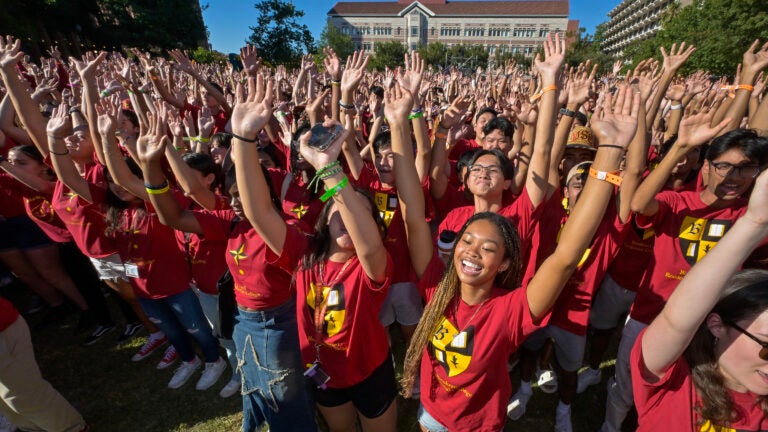

Fighting On to Victory
USC is home to top performers in the classroom and on the athletic field as well. Our teams have won 139 national championships — 100 men’s and 39 women’s titles. And Trojans have captured a gold medal in each Summer Olympics since 1912 — a run that’s sure to continue when the Games return to Los Angeles in 2028.
(USC Photo/John McGillen)
Top Headlines

The Olympic legend and the ESPN host joined an all-star roster to share their roads to success and how to navigate a changing sports landscape.

The Academy Award-winning actor and Emmy-winning producer visited the USC School of Dramatic Arts to discuss craft and collaboration

The yearlong experiential learning fellowship will connect five undergrads with the people, environments and ideas shaping contemporary live entertainment.

The trial will evaluate whether a blood test can help detect breast cancer earlier than mammograms alone.

USC’s Athletic Tradition
The most Heisman Trophy winners. The most Olympic gold medals and the overall medals. The most NCAA men’s individual titles. USC student-athletes set the standard.
Our Olympic Heritage
USC has had more Olympians, medalists and gold medalists than any school. And when the Games return to L.A., we’ll be front and center as the site of multiple competition venues — including the Los Angeles Memorial Coliseum, about to become the only venue in the world to have hosted three Olympiads.

How USC Viterbi engineers are helping Trojan football gain a competitive edge
USC Viterbi analytics students are creating a comprehensive database so the Trojans have quick access the insights needed to win on the gridiron.

USC student-athletes set yet another academic record
Trojan student-athletes established a new cumulative GPA record in the spring semester: 426 student-athletes earned a GPA of 3.0 or higher.

Stronger Than Hate: Trojan student-athletes recall life-altering trips to historic sites
USC Shoah Foundation and the Big Ten Conference provide Trojans with the opportunity to visit historical sites of the Holocaust and the Civil Rights Movement.

Women’s water polo team claims national title with win over Cal
Sunday’s 10-9 victory gives the Trojans their eighth all-time national championship.

Double Trojan reignites athletic passions thanks to Swim with Mike
Olivia Northcutt-Wyly credits the Swim with Mike Foundation, which raises scholarship money for disabled athletes, with helping her find her way when illness ended her competitive swimming career. The organization’s annual USC fundraiser is this weekend.

USC opens ‘amazing’ Bloom Football Performance Center
The new home of USC football doubles the size of the program’s space on campus, building on a championship legacy with an eye toward future success.

Spotlight: USC Annenberg School for Communication and Journalism
Powered by the creative energy of Los Angeles, state-of-the-art facilities, a faculty of leading scholars and practitioners, and a global network of industry partners, the USC Annenberg School for Communication and Journalism connects intellectual rigor and professional practice in ways few schools can. Students gain the knowledge, experiences and connections to shape the future of communication, journalism and public relations.

USC United Against Alzheimer’s
Learn how USC researchers and clinicians are making groundbreaking strides in the treatment, prevention and care of the debilitating disease.
Collaborating in Research and Care
This series showcases how USC researchers and clinicians are on the cusp of a revolution in Alzheimer’s prevention, making groundbreaking strides in the treatment, prevention and care of Alzheimer’s. In the near future, their discoveries promise to make the devastating disease a thing of the past.

Can we prevent Alzheimer’s disease within a decade?
USC researchers are on the cusp of a revolution in Alzheimer’s prevention. In the near future, their discoveries promise to make the devastating disease a thing of the past.

To reduce Alzheimer’s risk, focus on overall health
Researchers across USC are studying how lifestyle and environment influence dementia risk and resilience. They’re finding that what’s good for the body is also good for the brain.

How AI and advanced computing are accelerating Alzheimer’s research
Cutting-edge technologies developed by USC researchers are changing not just the pace of Alzheimer’s disease discoveries but also the ways scientists make those discoveries.

Caring Connections
Keck School of Medicine of USC practitioners connect Alzheimer’s patients and their caregivers to leading-edge research — and, just as importantly, to compassionate care.